It is a story we hear most weeks, told with the same slight embarrassment. The balcony was cleared out properly — the nest lifted, the twigs bagged, the ledge scrubbed with disinfectant, the whole thing done on a Sunday. It looked genuinely solved. Then, somewhere between five days and three weeks later, the same two birds were back on the same corner with a fresh mouthful of twigs.
Nothing went wrong. What happened is that you removed the mess and left the address, and pigeons are extraordinarily good at remembering addresses. This piece is about why that is, and what it means for the order in which you do things.
The short version: pigeons return to places where they have bred successfully, and so do the chicks raised there. Cleaning removes evidence, not attraction. The only step that ends the cycle is a physical barrier across every opening they use — and there are four of those on a typical balcony, not one.
Site fidelity: the reason it feels personal
City pigeons are descended from rock doves, which nest on cliff ledges, and almost everything they do on your balcony makes sense once you read it that way. A concrete ledge with a wall behind it and a slab overhead is not a compromise for them. It is a better cliff than most cliffs: flat, dry, sheltered from the worst of the wind, and a short flight from a reliable food supply.
The behaviour that matters here is what is usually called site fidelity — the tendency to return to a specific place that has worked before, rather than to look for a new one. A pair that fledged chicks off your AC bracket does not treat that bracket as one option among many. It is their site. They will come back to it after a clean-up, after a scare, after a season away, and the young they raised there grow up with a strong preference for the same kind of spot.
Layered on top of that is the navigational ability the birds are famous for. The reason pigeons were used to carry messages is that they are unusually good at finding one particular place from a long way off. That same ability is what makes a two-street relocation useless as a strategy, and it is why we never suggest trapping and moving birds — beyond the welfare question, they are simply better at coming home than the plan accounts for.
There is a social layer as well. Pigeons feed and roost in loose flocks, and a balcony that reliably holds a pair tends to get noticed by other birds. We would not want to overstate the mechanism — this is a general pattern rather than something we can measure from a ladder — but the practical observation is consistent: the balconies that go from one pair to four or five birds are almost always the ones that have been occupied, undisturbed, for a while.
Why your balcony and not the flat next door
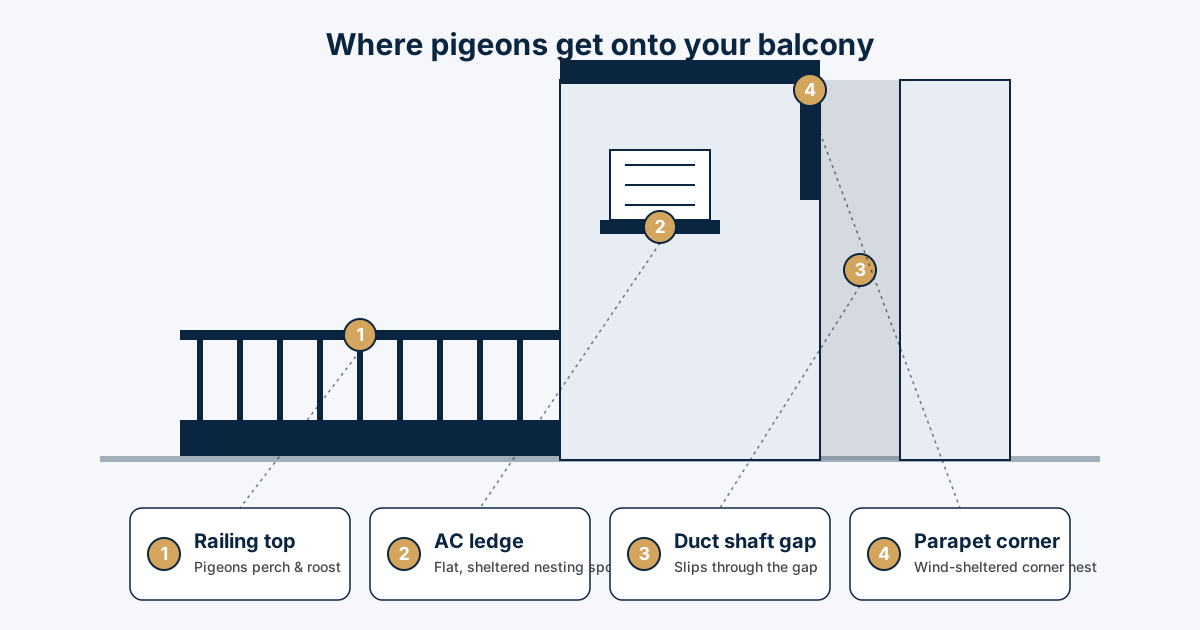
The single strongest predictor is whether there is a flat surface with something solid at its back. Look at your balcony the way a bird would:
An outdoor AC unit. The bracket makes a shelf, the wall makes a backstop, and the gap behind the unit is dark and sheltered. This is the most-used nesting spot we see, by a wide margin.
A parapet corner. The angle where two walls meet is wind-still even when the rest of the balcony is not, and it is out of sight from indoors, so nests there get found late.
A duct or shaft opening. Enclosed, warm, invisible from every flat, and usually the society’s responsibility rather than yours, which is why it gets left open for years.
The railing line. The one people point at first, and the one nests are least often built on. Railings are where the birds sit and where the droppings land; the nest is behind you.
Those four are the points marked on the diagram at the top of this page, and they are the same four we map in our guide to getting rid of pigeons permanently. Height and food supply then adjust the odds — the middle floors get more traffic than the ground floor or the terrace, and a building where somebody feeds grain daily puts every balcony downstream of a food source. But the architecture is the part you can change.
Why removal without a barrier always fails
Put the two facts together and the failure is obvious in hindsight. The pair is attached to the site. The removal takes away the nest. The site is untouched. Nothing in that sequence changes the bird’s opinion of your balcony, so the only variable is how long it takes them to rebuild — and with a bird that lays through most of the year, that is weeks rather than seasons.
The same logic explains why deterrents disappoint. Chilli, hanging CDs, plastic owls and gel all work by convincing the bird that a specific surface is unpleasant or unsafe. A bird that is strongly attached to a site does not abandon it over one bad surface; it moves four feet to the next one. That is the mechanism behind the complaint that people bring us most often — that the deterrent “worked” and yet the birds are still there — and we have gone through it product by product in pigeon net vs bird spikes vs gel.
Netting only the balcony face has the same shape of problem for the same reason. Close the railing line and leave the AC ledge open and you have not removed the birds; you have moved the nest a metre and taken it out of your line of sight. Families we work with often describe that as the moment the problem “came back”, when in fact it never left.
The clean-it-and-they-return cycle
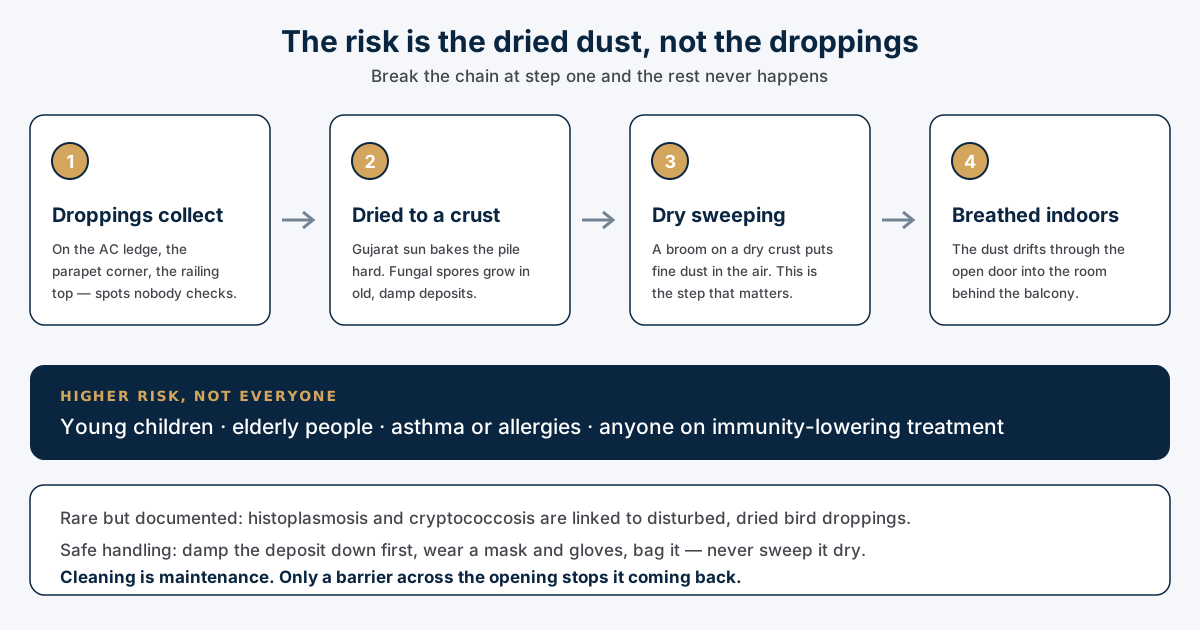
Written out, the loop most households are stuck in looks like this: the droppings build up, somebody spends a Sunday on the clean-up, the balcony is usable for a few weeks, twigs reappear, and a month or two later there is another Sunday to spend. Each round costs an afternoon and achieves nothing structural, and if the clean-up is done with a dry broom it also carries the one genuine health risk in this whole subject — dried droppings turned into airborne dust. That is worth reading properly before the next clean-up, in what pigeon droppings actually risk and how to clean them safely.
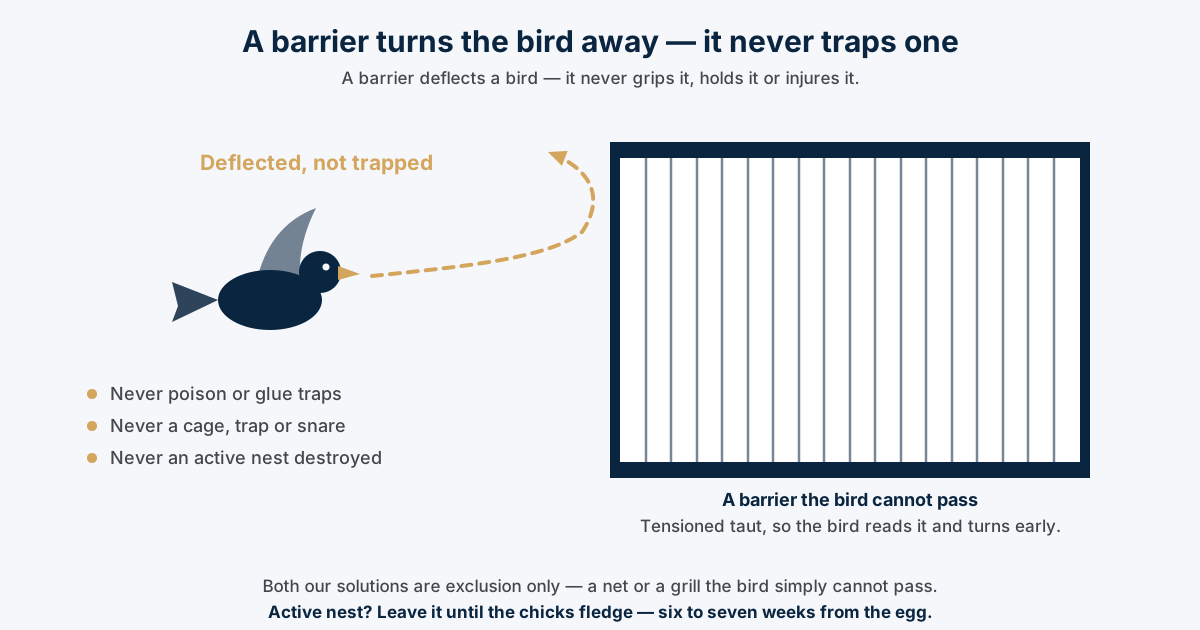
The sequence that breaks the loop is not more cleaning. It is clean, then close, in the same week — and close every opening, not the obvious one. If there is an active nest with eggs or chicks, wait it out; the chicks fledge roughly six to seven weeks from the egg, and the correct move is to close the gap the day after they leave rather than to disturb them, as we set out in keeping pigeons away without hurting them.
The two barriers, and which one to choose
A pigeon net is the temporary version of the barrier: tensioned mesh across the opening at ₹2,500–5,000 per installation, which stops the sitting and the nesting from the day it goes up. Temporary is the accurate word rather than a sales caveat — UV and monsoon take it to a gap in 2–3 years, which is roughly ₹12,000–20,000 across ten years of replacements, and the failure modes are laid out in how long a pigeon net lasts. We install nets in Ahmedabad, Surat, Vadodara, Rajkot and Gandhinagar only; everywhere else in India we fit the permanent option instead. Rates are on the pigeon net for balcony page.
An invisible grill is the permanent version: SS316 marine-grade cables tensioned at a 2-inch pitch, too tight for a pigeon to land on and too close together to pass through, at ₹95/sq.ft — about ₹9,500 once for a 100 sq.ft balcony, with a 10-year warranty and no replacement cycle to diarise. It is what we recommend where the household owns the flat, partly because the cost stops after the install and partly because the same cables make the balcony child-safe and pet-safe, which mesh does not. The specification is on our invisible grill for pigeons page.
Either barrier answers the site-fidelity problem the same way. The birds still remember the ledge and still want it. They simply cannot reach it, and after a few unsuccessful visits they settle somewhere they can.
What we would do this week
Walk the four points — railing line, AC ledge, duct or shaft gap, parapet corner — and write down which are open, because that list, not the mess, is the actual problem. Check for an active nest before touching anything and wait it out if there are eggs or chicks. Clean once, wet, with a mask on. Then close every opening on the list with whichever barrier matches how long you plan to be in that flat.
If the shaft gap turns out to be a common-area opening, that is a conversation with the society rather than a job for your balcony alone, and it is worth having early — a shaft that stays open keeps the building supplied with birds. A free site survey covers the rest: the surveyor marks each entry point, measures the openings, and quotes both barrier options on the same visit so the choice is made with the numbers in front of you.
References
Sources
- Histoplasmosis: the Histoplasma fungus spreads in bird and bat droppings that mix with soil and dustUS Centers for Disease Control and Prevention
- Psittacosis: Chlamydia psittaci infects many bird species and spreads to people through dried droppings and feather dustUS Centers for Disease Control and Prevention
Frequently Asked Questions
Common follow-up questions on this topic.
Why does my balcony get pigeons when my neighbour's balcony doesn't?
Usually because of the shape of it rather than anything you have done. Pigeons are descended from cliff-nesting birds, and what they are looking for is a flat surface, a solid wall behind it and something overhead — a ledge that feels like a sheltered rock shelf. An open, breezy, sun-hit balcony with nothing to tuck behind is a poor cliff. A balcony with an outdoor AC unit on a bracket, a deep parapet corner or a duct shaft opening is an excellent one, and those features vary flat to flat even in the same building. Two other things skew it: height, because middle and upper floors are away from ground-level disturbance without being as wind-exposed as the terrace, and food, because a balcony downwind of somebody who feeds grain daily gets visited far more often. If your neighbour's balcony is bare and yours has an AC ledge, the difference is the AC ledge.
Does removing the nest actually stop pigeons coming back?
On its own, no — it buys you a few weeks. Removing a nest takes away the material but leaves the site, and the site is what the pair is attached to. A pigeon that has raised chicks successfully on your AC ledge treats that ledge as home and comes back to it, and the chicks raised there tend to look for the same kind of spot too. So the nest goes, the ledge stays available, and a new one appears in the same corner within about a month. The removal is still worth doing — an abandoned nest holds droppings and can leave mites behind — but it has to be paired with closing the opening in the same week, before the pair starts the next clutch. If there are eggs or chicks in the nest right now, leave it alone until the chicks fledge, roughly six to seven weeks from the egg, and close the gap the moment they go. We have written up the humane sequence in detail in our guide to keeping pigeons away without hurting them.
Will pigeons leave my balcony in winter?
Not in Gujarat, and you should not plan around it. City pigeons are resident rather than migratory, and our winter is mild enough that there is no season where the balcony reliably empties out. What you may notice is a quieter patch — fewer eggs, less activity through the coldest weeks — which is easy to mistake for the birds having gone. They have not; they are still using the ledge, and breeding activity picks up again as it warms. We are installers rather than ornithologists, so treat the seasonal detail as a general pattern rather than a rule, but the practical point holds either way: a lull is not a departure, and the quiet weeks are actually the best time to do the work, because you are less likely to find an active nest in the way.
Choose your fix
Temporary net, or a permanent solution?
Pigeon net — temporary fix (2–3 years)
Installed by us in Ahmedabad, Surat, Vadodara, Rajkot & Gandhinagar only
See Pigeon Net PricingInvisible grill — permanent, child-safe
One-time SS316 marine-grade install. 10-year written warranty. No repeat cost, no re-tensioning.
Get Grill QuoteSee the full side-by-side: Pigeon net vs invisible grill → · Hindi mein padhein: kabutar jali vs invisible grill →
Ready to talk?
Free site visit. Itemised quote. No follow-up spam.
Same crew that measured you installs your grill. SS316 marine-grade only. 10-year written warranty.