If your pigeon net is going to fail this year, it is failing about now. Not in the May heat, and not in the still weeks of winter — in the middle of the monsoon, when the first heavy squall puts a full wind load on mesh that has spent nine months in the sun. August and September are our busiest months for exactly this call — “there is a gap and they are back.”
So this is the question worth answering properly before you buy, or before you decide whether the net you already have is worth repairing: how long does a pigeon net actually last on an Indian balcony? Not the number on the product listing. The number that shows up on your balcony.
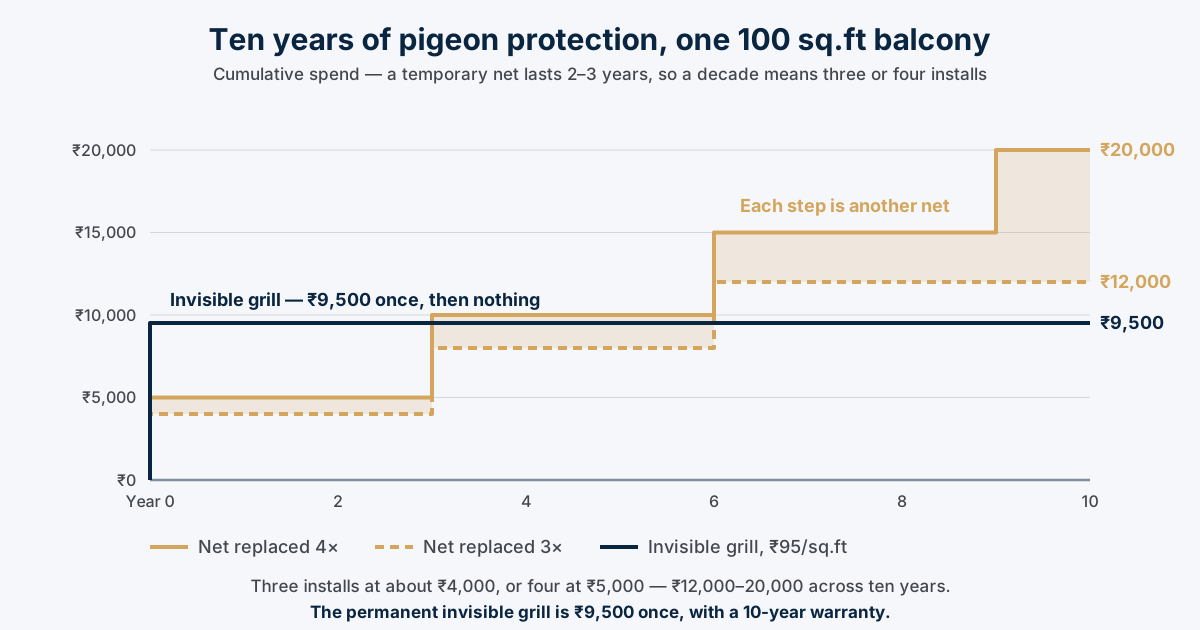
The short version: plan on 2–3 years to the first real gap, whichever mesh you buy. UV-stabilised HDPE is the better material and worth the difference over nylon, but the mesh fibre is rarely what fails first — the fixings and the perimeter rope are. Across ten years that is three or four installations, ₹12,000–20,000 (the floor is roughly three cycles at about ₹4,000 each; the ceiling four at ₹5,000). A pigeon net is a temporary solution and should be budgeted like one.
HDPE, nylon and the cheap plastic mesh: what each one buys you
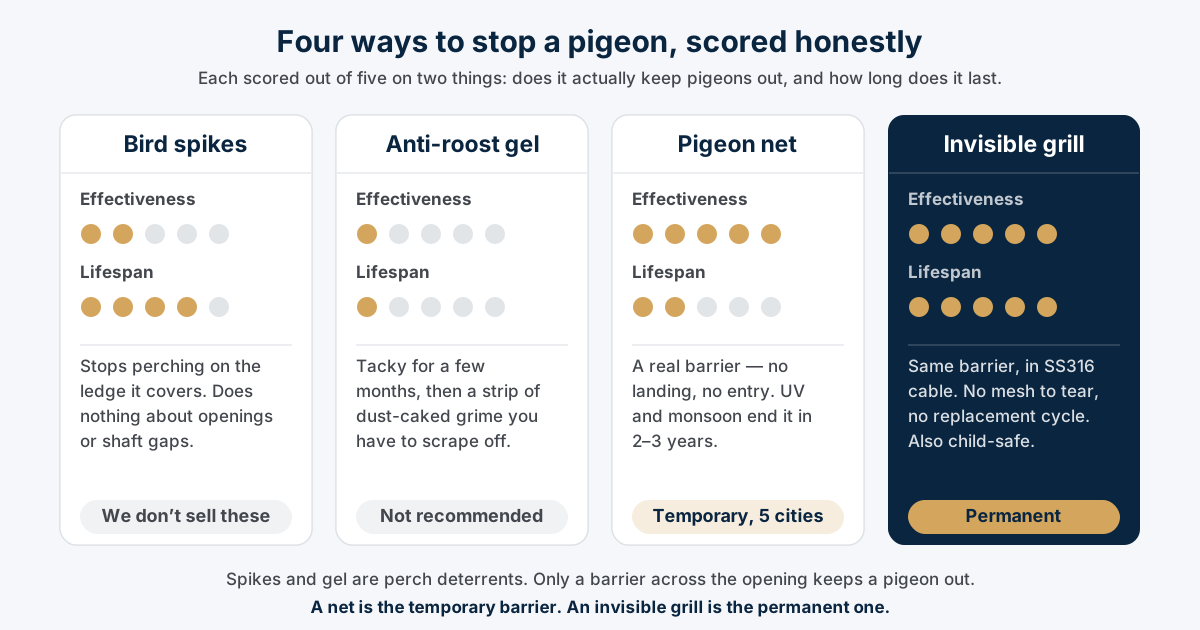
There are effectively three products sold as a pigeon net in India, and the price gap between them is real.
Cheap plastic mesh, sold by weight and cut to size, is the one behind the WhatsApp quote that comes in far under everybody else's. It is not UV-stabilised in any meaningful sense. On a south or west-facing Gujarat balcony it goes brittle inside a single hot season, and the first monsoon after that finishes it. If somebody quotes you a number that seems impossible, this is what you are being quoted for.
Nylon is the common mid-market answer and the default in most Indian metros. It is a genuine product, it holds tension well when new, and it is what most balconies actually get. Its weakness is exactly the one that matters here: nylon loses strength under ultraviolet faster than HDPE does, and it loses it invisibly.
UV-stabilised HDPE is the material worth paying the difference for. The stabiliser is not marketing — it genuinely slows the photo-degradation that turns a fibre chalky, and an HDPE net at year two is in visibly better condition than a nylon net of the same age on the same balcony.
Here is the part most comparisons skip, and it is the reason we quote the same 2–3 years for both. On the balconies we are called back to, the mesh is usually not the first thing to go. The failure is at the edge — the perimeter rope that has been rubbing against a rough parapet lip all year, the hook that has worked loose, the cable tie that has gone hard and snapped. Those age on their own schedule, and a better mesh does not slow them down. Buying HDPE is the right call and it does not restart the clock; it buys you a net that is still sound at the point where the fixings need attention.
The three ways a pigeon net actually fails
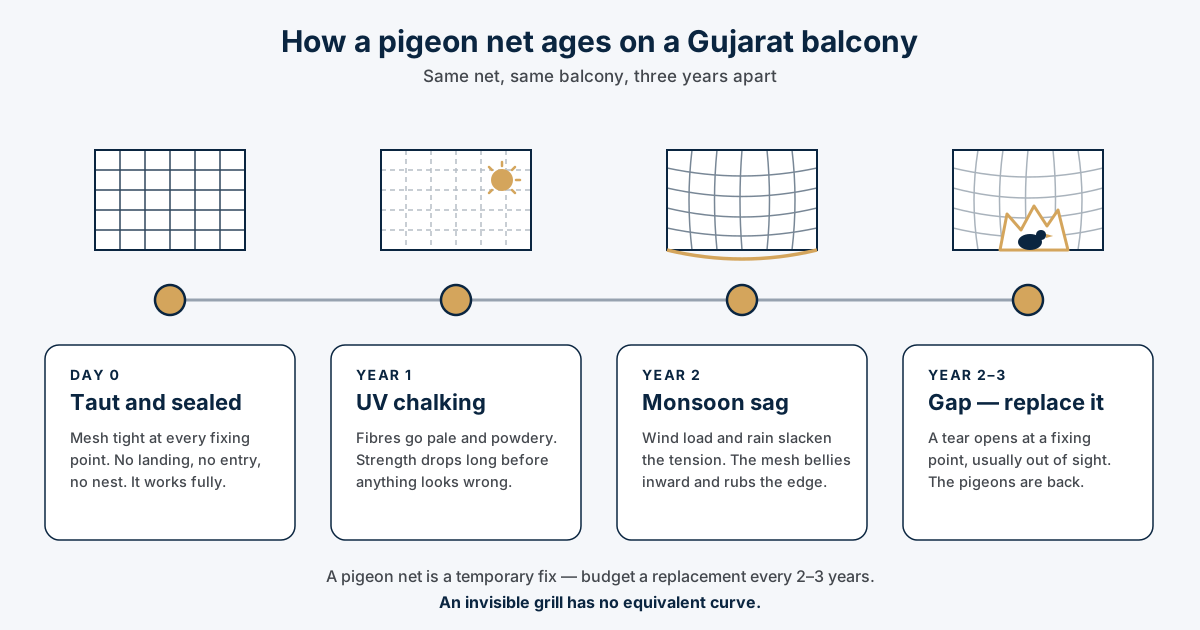
The timeline at the top of this page is drawn from the same balcony at four points in its life. Every net we take down has been through some version of it.
1. UV chalking — the first year, invisibly
Ultraviolet light breaks down the polymer at the surface of each fibre. The mesh goes pale, loses its slight gloss, and starts leaving a faint powdery residue if you rub it. That residue is the fibre itself. The important thing is that the strength loss runs well ahead of the appearance: a net at eighteen months looks fine from your sofa and has already given up a large share of what it had on day one. There is no alarm for this stage, which is why so many people are surprised when the net “suddenly” tears.
2. Sagging — the second year, after the rain
A net works because it is tight. Slack mesh is a hammock, and a hammock has a bottom edge that lifts. Sag comes from three places at once: fixings that have pulled a millimetre or two each, fibre that has stretched and no longer springs back, and the sheer weight of water and accumulated dust after a monsoon week. Once the mesh bellies inward it also starts rubbing wherever it touches, which quietly manufactures the third failure.
3. Tears and gaps — year two to three, out of sight
The tear almost never appears in the middle of the panel where you would see it. It appears at a corner, at a fixing point, or along the top edge above eye level — and a pigeon needs a gap of only a few inches. This is the failure that ends the net's useful life, and the reason it matters is timing: the household usually finds out from droppings on the floor or a nest behind the AC unit, weeks after the gap opened.
The two-minute monsoon check: after the first heavy week of rain, stand inside and look up at the top edge and the two top corners, which is where gaps open and where nobody looks. Then push the mesh gently with a flat palm at the centre of each panel — if it moves more than a couple of inches, the tension has gone. Then rub a corner of the mesh between your fingers. Powder on your fingertips means the fibre is chalking and a re-tension will not save it.
What the replacement cycle actually costs over ten years
This is where a 2–3 year lifespan stops being a technical detail. A pigeon net installation is ₹2,500–5,000 for a typical balcony, and a replacement is essentially a fresh installation — the old mesh comes down, new mesh goes up. Run that on the real cycle and ten years looks like this:
Pigeon net, the temporary option: three or four installations at ₹2,500–5,000 each — ₹12,000–20,000 across ten years, plus the gap weeks each time between the tear opening and the crew arriving.
Invisible grill, the permanent option: ₹95/sq.ft, so ₹9,500 once for a 100 sq.ft balcony, with a 10-year warranty and no replacement cycle to budget for.
Across those ten years the temporary route costs ₹12,000–20,000 against ₹9,500 once for the grill — and at the end of it you are still on the clock, with the next replacement already due. That is not an argument that nobody should buy a net — it is an argument for knowing which of the two situations below you are in before you decide.
When a net is still the right call
We install pigeon nets, and there is a real set of households for whom the temporary option is the correct answer rather than a compromise.
You rent. A net comes down cleanly at the end of a tenancy and does not turn into a deposit argument. If you are in a rented flat with a pigeon problem, take the temporary net and diarise the replacement.
You are moving within two or three years. You will never reach the point where the replacement cycle costs you anything, so the cheap option is genuinely the cheap option.
The money is not there this month. A temporary net fitted this week beats a permanent grill postponed for two years while droppings pile up on the balcony floor. The best fix is the one that gets installed.
Two conditions if you go this route. Fit it across every opening, not just the balcony face — the AC ledge and the shaft gap are where the nest goes, and the four entry points guide walks through all of them. And ask for UV-stabilised HDPE by name rather than accepting whatever is on the van. Our pigeon net for balcony page has the rates and the spec; we install nets in Ahmedabad, Surat, Vadodara, Rajkot and Gandhinagar only, and everywhere else in India we fit the permanent option instead.
The version of this that has no timeline
An invisible grill is the permanent answer to the same problem, and it exists on this page because the failure modes above simply do not apply to it. SS316 marine-grade cable does not chalk in ultraviolet, does not stretch and sag after a monsoon, and has no mesh to tear. Tensioned vertically at a 2-inch pitch, a pigeon cannot land on it and cannot pass between the cables. There is no year-two inspection, no re-tensioning visit, and no judgement call about whether a four-year-old net is still a four-year-old net.
At ₹95/sq.ft it is about ₹9,500 for a 100 sq.ft balcony, once, with a 10-year written warranty — and the same installation makes the balcony child-safe and pet-safe, which mesh does not, because net mesh is not load-rated. The side-by-side is laid out on our pigeon net vs invisible grill page if you want both columns in one view.
What we would do with your net this week
Run the two-minute monsoon check above. If the mesh is sound and the sag is coming from fixings, get it re-tensioned now rather than in October — a tight net through the rest of the monsoon is worth more than a repair after the damage. If the fibre powders on your fingers, stop planning repairs and decide instead which of the two options you are buying next, because that net is finished whether or not it has visibly torn.
And while the balcony is open, deal with what the net has been catching. Dried droppings are worth handling properly rather than sweeping dry, and we have written up the sensible way to do that in the guide to pigeon droppings and health risks. If you would rather have someone look at it, a free site survey covers the inspection, the measurements and a quote for both routes on the same visit — so you are comparing them on your actual balcony rather than in the abstract.
Frequently Asked Questions
Common follow-up questions on this topic.
How long does a pigeon net last — HDPE or nylon?
Plan on 2–3 years to the first real gap, whichever you buy. UV-stabilised HDPE is genuinely the better material and worth paying for over plain nylon or the cheap plastic mesh sold by the kilo — the fibre holds its strength longer and chalks more slowly. But on an exposed Indian balcony the mesh fibre is usually not what fails first. The failure is at the edges: the perimeter rope, the fixing points and the tension. Those age at the same rate regardless of what the mesh is made of, which is why we quote 2–3 years for a pigeon net either way and treat it as a temporary solution rather than a purchase you make once. A shaded, north-facing, low-wind opening will beat that. A west-facing balcony in Ahmedabad with full afternoon sun will not.
Does the monsoon damage pigeon nets?
The monsoon does not usually create the damage — it reveals it. Nine months of UV has already made the fibre brittle and cost it elasticity; then the first serious squall puts a heavy, repeated wind load on a net that can no longer stretch and recover. What gives way is the weakest point, which is almost always a fixing: a hook that pulls, a cable tie that snaps, a corner where the perimeter rope has been sawing against a rough edge all year. Add the weight of water on the mesh and the slackening that follows, and a net that looked fine in May has a sag and a gap by August. That is why we tell people to inspect after the first heavy week of rain rather than at the end of the season — by the end of the season a pair of pigeons has usually already found the gap.
Can a sagging pigeon net be re-tensioned instead of replaced?
Sometimes, and it is worth asking. If the net is in its first two years, the mesh still looks and feels like mesh rather than chalk, and the sag comes from fixings that have pulled rather than from fibre that has stretched permanently, re-tensioning is a real repair and buys you a season or more. If the fibre has gone pale and powdery — rub it between your fingers and see whether it leaves a residue — re-tensioning a degraded net just moves the load onto the next weakest point, and you will be back within months. The honest test is the perimeter rope. If that has gone hard and the knots are brittle, replace rather than repair. Either way, a re-tensioned net is still a temporary solution on a 2–3 year clock; you have not restarted it.
What does replacing a pigeon net cost?
A pigeon net installation runs ₹2,500–5,000 for a typical balcony, and replacement is broadly a fresh installation rather than a discount job, because the old mesh comes down and new mesh goes up. On a 2–3 year cycle that is three or four installs across ten years, so ₹12,000–20,000 in total. The number people forget to add is the gap weeks — the time between a tear appearing somewhere you cannot see it and the crew coming back — because that is when the droppings and the nesting restart. For comparison, an invisible grill is ₹95/sq.ft, about ₹9,500 once for a 100 sq.ft balcony, with a 10-year warranty and no replacement cycle at all. That gap is the whole argument, and it is why we are straight with customers that the net is the temporary option.
Choose your fix
Temporary net, or a permanent solution?
Pigeon net — temporary fix (2–3 years)
Installed by us in Ahmedabad, Surat, Vadodara, Rajkot & Gandhinagar only
See Pigeon Net PricingInvisible grill — permanent, child-safe
One-time SS316 marine-grade install. 10-year written warranty. No repeat cost, no re-tensioning.
Get Grill QuoteSee the full side-by-side: Pigeon net vs invisible grill → · Hindi mein padhein: kabutar jali vs invisible grill →
Ready to talk?
Free site visit. Itemised quote. No follow-up spam.
Same crew that measured you installs your grill. SS316 marine-grade only. 10-year written warranty.