You have probably already tried two of these: chilli powder along the parapet, a plastic owl from the hardware shop, a string of old CDs flashing in the sun. Each one worked for about a week. Then the same pair of pigeons came back to the same corner, and by the time you noticed there were two eggs in a nest of twigs behind the AC unit.
That pattern is not bad luck and it is not because you did it wrong. It is what pigeon control looks like when the tools are scare devices. This guide is written the way we would explain it standing on your balcony: what each popular method actually buys you in days or weeks, why the birds keep returning, and the two things that genuinely end it. We fit both of those two things for a living, so read the cost section sceptically — the numbers are all here and you can check them.
The short version: nothing that relies on scaring a pigeon works for more than a few weeks. Smells wash off, decoys get perched on, gels dry out. Only a physical barrier across the opening ends it. A pigeon net is the cheap, temporary version — ₹2,500–5,000, replaced every 2–3 years. An invisible grill is the permanent version — ₹95/sq.ft once. Everything else on this page is a delay, not a fix.
Why pigeons picked your balcony — and where they get in
The city pigeon is a rock dove. Before there were buildings it nested on cliff ledges: a flat surface, a wall at its back, and a roof over the top. Your balcony is a better cliff than any cliff — it has all three, plus no predators, plus somebody two floors down who puts out grain every morning.
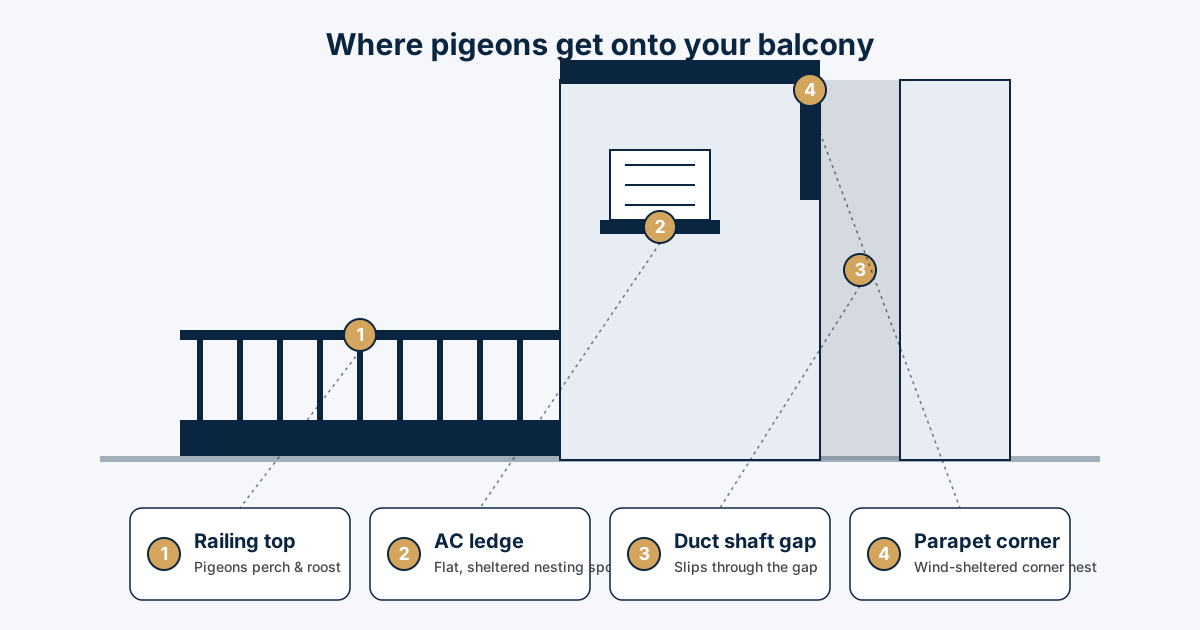
There are four places they actually get in, and the diagram at the top of this page marks all of them. Walk your own balcony and check each one:
The railing top. This is the perch, not usually the nest. It is where they land, watch, and leave the droppings you see first. It is also the only spot most deterrents are aimed at, which is why most deterrents fail — you make the railing unpleasant and the bird simply moves to point 2.
The AC outdoor unit ledge. The single most common nesting site in Indian flats. Flat, sheltered by the unit itself, warm, and nobody looks there for months. If you have found a nest, this is usually where it was.
The duct or shaft gap. The narrow opening into a service shaft, often on the utility-balcony side. Pigeons need a gap of only a few inches. Once inside a shaft the mess accumulates for years because nobody can reach it.
The parapet corner. The wind-sheltered angle where two walls meet, usually behind whatever is stored there. Second most common nest site after the AC ledge.
Two facts explain why they keep coming back. First, pigeons show strong site fidelity — a pair that successfully raised chicks on your ledge will return to that exact ledge, and so will those chicks. Second, they breed almost year-round in Indian cities: two eggs per clutch, about 18 days to hatch, another four weeks or so before the chicks fledge, and the pair can start again within weeks. Clear a nest without closing the gap and you have bought yourself roughly one month.
What doesn't work for long: CDs, gel, sprays, owls and spikes
Every method in this section is real, sold widely, and has some effect on day one. The problem is the shape of the curve after day one. Pigeons are cautious birds with excellent memories, which sounds like it should help you — it does the opposite. A cautious bird investigates a new object, learns it is harmless, and then ignores it permanently.
Hanging CDs, reflective tape and shiny strips
Cheapest thing on the list and the one everyone tries first. The flash startles a bird that has never seen it. Expect roughly one to two weeks before the pigeons treat the CD as furniture. On a still day it does nothing at all, because the whole effect depends on wind.
Plastic owls, hawk decoys and rubber snakes
A static plastic owl is the most reliably useless product in this category, and it is not close. Pigeons in Indian cities nest on ledges a few metres from real kites and crows; a moulded plastic bird that never moves is identified as not-a-threat within days. It is common to find a pigeon sitting on the owl. Decoys that genuinely move last longer, but you are still measuring the effect in weeks.
Chilli, pepper, cinnamon and other gharelu sprays
Capsaicin does irritate a bird that lands directly on it, so this is not pure superstition. But pigeons find food and home by sight, not smell, so the spray only affects the specific surface it is sitting on — and Gujarat sun and one monsoon shower remove it in three to seven days. As a permanent answer it fails; as a way to make a particular ledge unattractive for a fortnight while you arrange something real, it is fine.
Anti-roost gel
Sticky polybutene gel on the railing makes the surface unpleasant underfoot. Two problems. It collects dust and goes hard, typically inside six to twelve months in Indian conditions, at which point it is a stripe of grime you now have to scrape off. And a bird that gets badly gummed can be genuinely harmed — feathers that lose their waterproofing are a slow death sentence. We do not recommend it, and not only on ahimsa grounds.
Ultrasonic and sound devices
Pigeon hearing sits in roughly the same range as ours. A device that is inaudible to you is very likely inaudible to the bird, and one that is audible to the bird is audible to your neighbours. There is no credible evidence of lasting effect on pigeons.
Spikes
Spikes are the one item on this list that does something real: a properly fitted spike strip genuinely stops a pigeon perching on the strip it covers. Three things go wrong in practice. Pigeons move to the uncovered surface six inches away — the AC ledge, the parapet corner — because the spikes changed the perch, not the address. Wide-gap spikes get used as a nest frame, with twigs wedged between the wires. And spikes do nothing at all about entry into a shaft or a duct. Spikes are a perch deterrent for one narrow surface, which is a genuinely useful thing and a completely different thing from getting rid of pigeons. We put spikes side by side with nets and gel in our full pigeon net vs spikes vs gel comparison if you want the longer version of this assessment.
One test that saves you three months: before you buy any deterrent, ask whether it stops the bird landing or stops the bird entering. Everything in the list above is the first kind. A pigeon that cannot land on your railing but can still reach the AC ledge has not been removed from your balcony — it has been relocated by four feet, out of your line of sight, which is why people think a product worked until they find the nest.
The two things that actually work
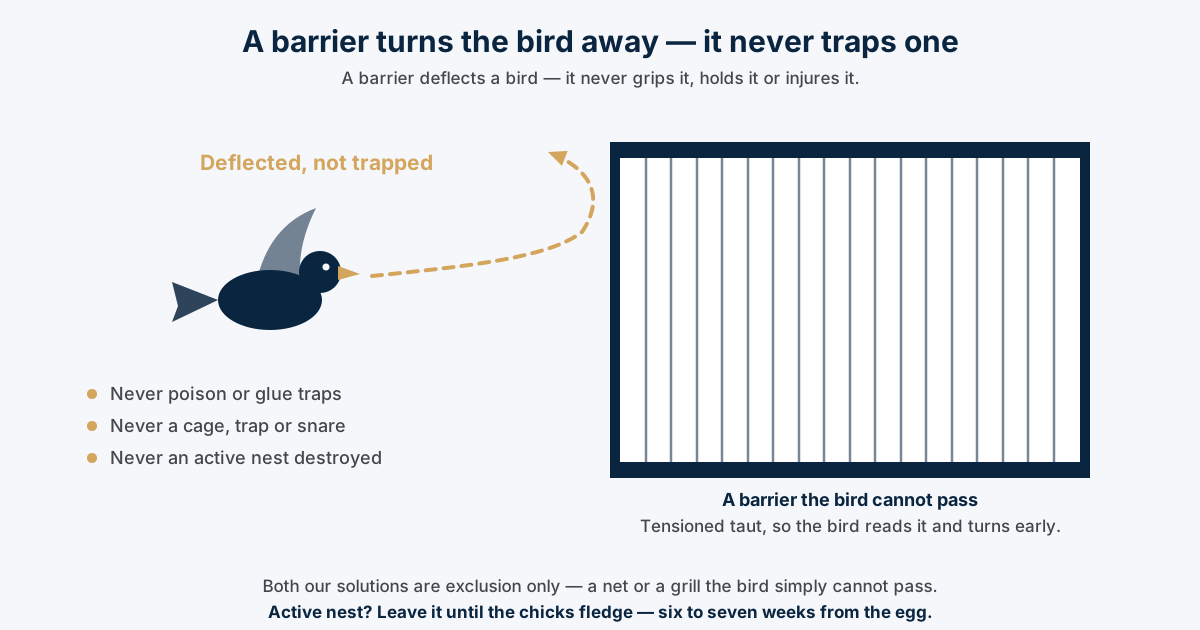
Both are physical barriers across the opening. That is the entire category. The choice is only between a temporary barrier and a permanent one.
A pigeon net — the temporary fix
A tensioned HDPE or nylon mesh across the balcony opening, edge to edge. It works immediately and completely: no landing, no entry, no nest. Installed cost for a typical balcony is ₹2,500–5,000, and you can see the per-sq.ft rates on our pigeon net for balcony page.
The honest caveat, which we put on every page that offers one: a net is a temporary solution. UV light makes the mesh brittle, monsoon wind slackens the tension, and by year two or three there is a gap — usually at a fixing point, usually somewhere you cannot see from the sofa. Budget a replacement every 2–3 years. We install nets in Ahmedabad, Surat, Vadodara, Rajkot and Gandhinagar only; everywhere else in India we fit the permanent option instead.
An invisible grill — the permanent fix
SS316 marine-grade steel cables tensioned vertically at a 2-inch pitch across the opening. A pigeon cannot land on a 2 mm cable, cannot pass between cables 50 mm apart, and has nothing to tear — the failure mode that kills nets does not exist here. From two or three metres back you look straight through it, which is the reason people who reject nets on appearance still accept a grill.
The same install also makes the balcony child-safe and pet-safe, which a net does not: net mesh is not load-rated and no honest installer will tell you otherwise. Our invisible grill for pigeons page has the spec, the cable pitch and the warranty terms.
Do all four points, not just the railing. Whichever barrier you choose, cover every opening the diagram marks — railing line, AC ledge, shaft gap, parapet corner. The most common installation mistake in this category is netting the balcony face and leaving the AC ledge open, which relocates the nest by a metre and convinces the homeowner the product failed.
The ahimsa way — clearing them without harming a bird
Nothing on this page needs a pigeon to be hurt, and if a vendor suggests poison, glue traps or shooting, end the conversation. Beyond the ethics, it does not even work: a killed or removed bird is replaced by another within weeks, because the ledge is still a good ledge. Exclusion works precisely because it changes the property, not the population.
The one thing to get right is timing. Check the nest before you touch it. An empty nest of twigs can be cleared and the gap closed the same day. A nest with eggs or chicks should be left alone until the chicks fledge — roughly six to seven weeks from the egg — and then closed off immediately, that week, before the pair starts the next clutch. Wear a mask and gloves when clearing dried droppings and damp the material down first rather than sweeping it dry.
And if somebody in your building feeds pigeons daily on the terrace, your balcony is downstream of a food source. That conversation with the society is worth having, gently, alongside the barrier.
We have written a full guide to keeping pigeons away without hurting them, with more detail on nest-clearing timing and the humane methods worth your time.
Pigeons in your AC unit, duct or shaft
The outdoor AC unit deserves its own section because it is the most common nest site and the most expensive one to ignore. Nesting material and droppings pack into the condenser fins, the unit loses its ability to throw heat, the compressor runs longer and hotter, and the first symptom you notice is a cooling complaint and a service bill — not a bird.
Cleaning it is necessary and insufficient. Unless the ledge and the gap behind the unit are physically closed, the pair returns to the cleaned ledge within the month, because from the pigeon's point of view you just tidied its house. Both barriers handle this: a net or jali panel across the AC opening, or the grill cables carried across the same opening. Duct and shaft gaps are the same principle and are usually a society matter rather than a flat-owner one, so raise it with your secretary — a shaft that has been open for a decade holds a decade of mess.
We have written a full guide to pigeons nesting in an AC unit, duct or shaft if that is the specific problem on your balcony.
Cost reality: ten years, both routes
This is where the temporary-versus-permanent choice stops being philosophical. Numbers for a standard 100 sq.ft balcony, at our published rates:
Pigeon net: ₹2,500–5,000 per installation, lasting 2–3 years. Over ten years that is three or four installs — ₹12,000–20,000 (the floor is roughly three cycles at about ₹4,000 each; the ceiling four at ₹5,000) — plus the gap weeks between noticing the tear and getting the crew back. Rates are on the pigeon net price page.
Invisible grill: ₹95/sq.ft in Gujarat, so ₹9,500 once for the same balcony, with a 10-year warranty and no repeat spend.
Deterrent products: a few hundred rupees each, repeatedly, indefinitely, while the problem continues. This is the option most households actually spend the most on over five years, in small amounts, without ever solving anything.
The crossover is early — the second net install already costs more than the grill did once — but the net is still the right answer for a real set of people. If you rent, if you are moving within two or three years, or if ₹9,500 this month is genuinely not available, take the temporary net, fit it properly across all four points, and diarise the replacement. That is a good decision, not a compromise.
If you own the flat and expect to be there in five years, paying twice for netting to avoid paying once for a grill is the one outcome worth avoiding — especially when the grill also solves the child-safety question you would otherwise be budgeting for separately.
What we would do on your balcony
Walk the four points and write down which ones are open. Clear any empty nest and close that gap the same week; if there are eggs, mark the calendar six to seven weeks out and close it then. Skip every scare product — they cost little individually and a lot cumulatively, and the three months you spend testing them is three months of droppings on the floor. Then pick the barrier that matches how long you will live there: the temporary net if you are short-term or renting, the permanent grill if you are not.
If you would rather have someone else do the walk, a free site survey covers it — the surveyor marks the four entry points, measures the openings, and quotes both options in the same visit so you can compare them on your actual balcony rather than in the abstract.
References
Sources
- Histoplasmosis: the Histoplasma fungus spreads in bird and bat droppings that mix with soil and dustUS Centers for Disease Control and Prevention
- Psittacosis: Chlamydia psittaci infects many bird species and spreads to people through dried droppings and feather dustUS Centers for Disease Control and Prevention
Frequently Asked Questions
Common follow-up questions on this topic.
What smell keeps pigeons away?
Honestly — none of them, for long. Chilli powder, black pepper, cinnamon, garlic paste and peppermint oil are the standard gharelu answers, and they do irritate a bird that lands directly on the treated surface. But pigeons navigate by sight, not smell, so a smell is a mild contact irritant rather than a wall. In practice a chilli or pepper spray on a parapet stops working in three to seven days: one shower or two days of Gujarat sun and the capsaicin is gone. If you re-apply every week for a year you have spent more time on it than a net installation takes, and the pigeons still nest the week you forget.
Do fake owls, plastic snakes and hanging CDs work?
For a few days, then no. Every one of these is a scare device, and pigeons habituate to anything that never actually hurts them. Field experience across Indian high-rises is consistent: a static plastic owl is being perched on within a week or two, reflective CDs stop registering once the bird learns the flash predicts nothing, and a rubber snake is ignored almost immediately. Moving devices — a hawk kite that actually flies, a windmill spinner — last a little longer because the movement is unpredictable, but they still fail within a season. If you want to test this cheaply, hang the CDs, and mark your calendar for two weeks later.
Is it legal to remove a pigeon nest in India?
We are not lawyers and this is not legal advice, so treat this as the general practice we follow rather than a ruling. In day-to-day practice the feral city pigeon is not treated like a protected wild bird, and clearing an empty nest from your own balcony is normally handled as routine property maintenance — though we would not tell you it is definitively unprotected, because how the Wildlife (Protection) Act schedules apply to it is genuinely argued over. None of that changes the practical rule, which is the part that matters: leave an active nest alone until the chicks are gone. Once a nest holds eggs or hatchlings, the humane and widely accepted practice is to wait until the chicks fledge — roughly six to seven weeks from the egg — and close the gap immediately afterwards. Housing societies sometimes have their own rules about balcony enclosures and common ducts, so check with your secretary before any work on a shaft or shared ledge. Never use poison, glue traps or anything that injures the bird — apart from the cruelty, it usually leaves you with a dead pigeon in a place you cannot reach.
What is the permanent solution for pigeons on a balcony?
A physical barrier the bird cannot pass, fitted across every opening rather than just the railing. There are two versions. A pigeon net (kabutar jali) is the cheap one at roughly ₹2,500–5,000 per install, and it is explicitly a temporary solution — UV light makes the mesh brittle and it needs replacing every 2–3 years, so ten years of netting costs ₹12,000–20,000 across three or four installs. An invisible grill is the permanent one: SS316 marine-grade cables tensioned at a 2-inch pitch, too tight for a pigeon to land on or squeeze through, at ₹95/sq.ft in Gujarat — about ₹9,500 for a 100 sq.ft balcony, once, with a 10-year warranty and nothing to re-do. Nothing else on the deterrent list is permanent, because everything else depends on the pigeon continuing to be fooled.
Choose your fix
Temporary net, or a permanent solution?
Pigeon net — temporary fix (2–3 years)
Installed by us in Ahmedabad, Surat, Vadodara, Rajkot & Gandhinagar only
See Pigeon Net PricingInvisible grill — permanent, child-safe
One-time SS316 marine-grade install. 10-year written warranty. No repeat cost, no re-tensioning.
Get Grill QuoteSee the full side-by-side: Pigeon net vs invisible grill → · Hindi mein padhein: kabutar jali vs invisible grill →
Ready to talk?
Free site visit. Itemised quote. No follow-up spam.
Same crew that measured you installs your grill. SS316 marine-grade only. 10-year written warranty.