By the time most people call us they have three quotes on their phone: a spike-fitting rate per running foot, a tube of anti-roost gel somebody recommended, and a net quote. Each vendor was confident. Each said theirs was the answer. So the question arrives as “which one is best?” — and that is the wrong question, because these four products are not competing to do the same job.
Two of them stop a bird standing on a surface. Two of them stop a bird entering a space. Sort them that way first and the choice gets much simpler, and much cheaper. We fit two of the four for a living and sell neither of the other two, so read the verdicts on those with that in mind — we have nothing to gain from talking you out of spikes.
The short version: spikes work, narrowly — on the strip of ledge they cover, for years, and we do not sell them. Gel is the shortest-lived thing on the list and a genuine welfare risk. Ultrasonic devices do nothing at all. Only a barrier across the opening actually keeps a pigeon out of a balcony: a pigeon net is the temporary barrier, an invisible grill is the permanent one.
Score everything on two axes, not one
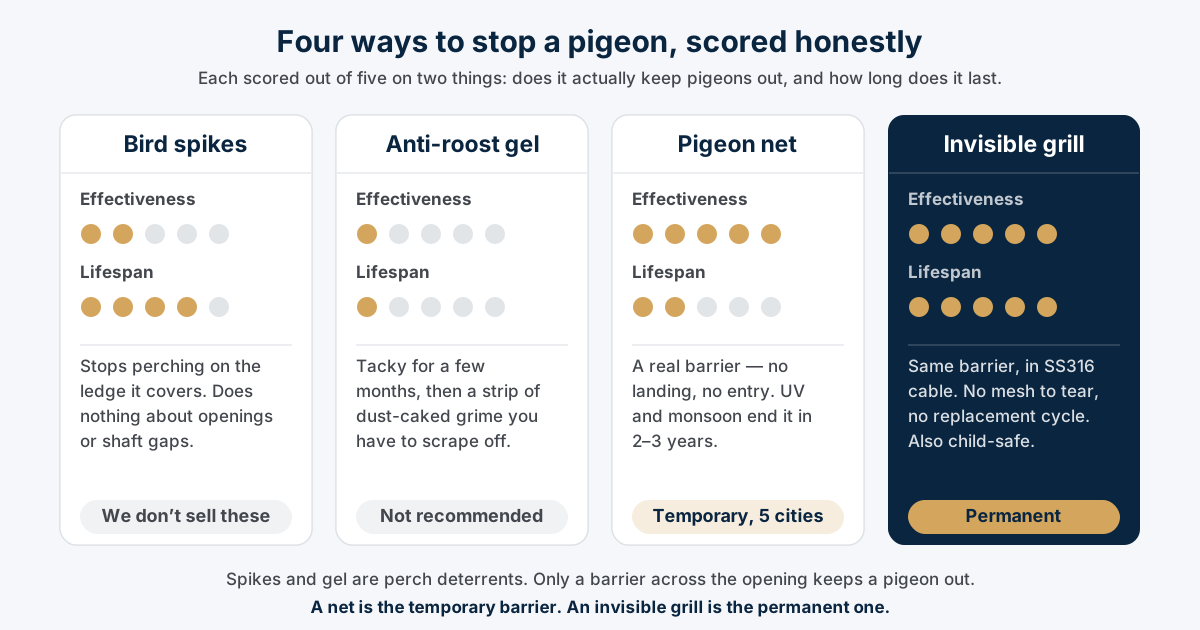
The grid at the top of this page rates each option out of five on two things, and you need both numbers to make a decision.
Effectiveness is not “does it annoy a pigeon.” It is: does it stop the bird reaching the place you care about? A product can be completely effective on the ten inches it covers and score low here, because your balcony is not ten inches.
Lifespan is how long it holds that performance in Indian conditions — not the shelf life on the box. Ultraviolet, dust and a surface that gets genuinely hot are what shorten it, and they punish the four products very differently. Spikes score well on this axis and badly on the first. A net scores the reverse. Only one option scores well on both, and it is the one with no consumable in it.
Bird spikes: real, narrow, and we don't sell them
Let us give spikes their due, because a lot of writing on this topic is dishonest about them. A spike strip is not a scare device. It does not depend on the pigeon being fooled, so it does not stop working when the pigeon stops being fooled. Stainless pins on a polycarbonate base, fitted properly, will keep a bird off that strip for years. That is more than almost anything else on the deterrent shelf can say.
What goes wrong is geometry, fixing and coverage — in that order.
Spikes cannot span an opening
This is the structural limit and no product improvement fixes it. Spikes are fitted onto a surface. A balcony opening is not a surface, it is a gap — and so is the shaft mouth, the duct slot and the space behind the AC unit where the nest usually goes. If your pigeons are coming into the balcony rather than only standing on the parapet, spiking the parapet relocates them inward, which reads as the product failing when it is actually the product being asked to do something it was never built for.
The base fixing is what fails in Gujarat
Spike strips are fixed one of two ways: mechanically, with screws or rivets into the parapet, or with a bead of silicone or construction adhesive. Adhesive is faster, cheaper and what most one-visit crews use. It is also the part that gives way here, because a west-facing parapet in May is far hotter than the air temperature you felt when you agreed the quote, and the bond softens and creeps under that heat before the pins ever dull. If you do buy spikes, ask specifically how the base is fixed and pay the difference for mechanical fixing.
One row rarely covers a parapet
Quotes are usually written per running foot for a single row, and a single row is right for a thin railing top. It is not right for the wide masonry parapets common in Indian flats, where a bird lands on the uncovered half and ignores the spiked half entirely. Wide-gap spikes cause a second problem: pigeons wedge twigs between the wires and nest in the frame the spikes provide. If a quote does not state the parapet width it measured and the number of rows, it has not been measured.
There is also an honesty point that belongs here rather than buried. A badly installed spike strip — cut ends left proud, a row set into a corner a bird is still determined to use — can injure a pigeon, and that is one of the few real welfare risks in this category. It is avoidable with decent installation, and we go through it properly in our guide to keeping pigeons away without hurting them.
So: buy spikes for a perch problem on one defined ledge. We do not stock them, do not fit them, and will not quote you for them. If that is genuinely what you need, a local bird-control fitter is the right call and we would rather say so.
Anti-roost gel: the shortest-lived thing on this list
Polybutene gel is laid in beads along a ledge and works by being permanently tacky — a pigeon that lands finds the footing unpleasant and leaves. On day one it does exactly that. The trouble is that everything which makes it work is temperature-sensitive and dust-sensitive, and an Indian balcony has plenty of both.
Tackiness drops as the surface heats. A sun-facing parapet runs substantially hotter than the shade temperature, and on those surfaces the gel thins, spreads wider than the bead you paid for, and runs down the face of the masonry. On a porous stone or an emulsion-painted parapet that mark can be very difficult to get out. Meanwhile airborne dust settles into the surface and cakes. The end state is a hard, gritty crust — no longer sticky, no longer a deterrent, and now a stripe you have to scrape or solvent-clean before anything else can be fitted there.
Then there is the welfare objection, which for a lot of the households we work with is the one that ends the conversation. A bird that gets properly gummed can lose the waterproofing of its feathers, and that is a slow harm rather than a deterrent. Between the re-application cycle, the staining and that, we do not recommend gel to anybody and we do not sell it.
Ultrasonic and sound devices: no
Short section, because it deserves one. Pigeon hearing sits in roughly the same range as ours, so a unit that is silent to you is very likely silent to the bird — and one the bird can hear is one your neighbours can hear. Even then, sound is a scare stimulus, and pigeons habituate to scare stimuli fast: a noise that never turns out to mean anything becomes background within days. Every other scare product on the market — decoys, reflective tape, hanging CDs — dies on the same curve, and the full balcony guide walks through each of them with the timelines.
The pigeon net: an effective barrier on a clock
Now the two products that do the other job. A tensioned HDPE or nylon mesh across the balcony opening stops landing and entry outright, immediately and completely, in a way no amount of spiking can. On the effectiveness axis it is a five.
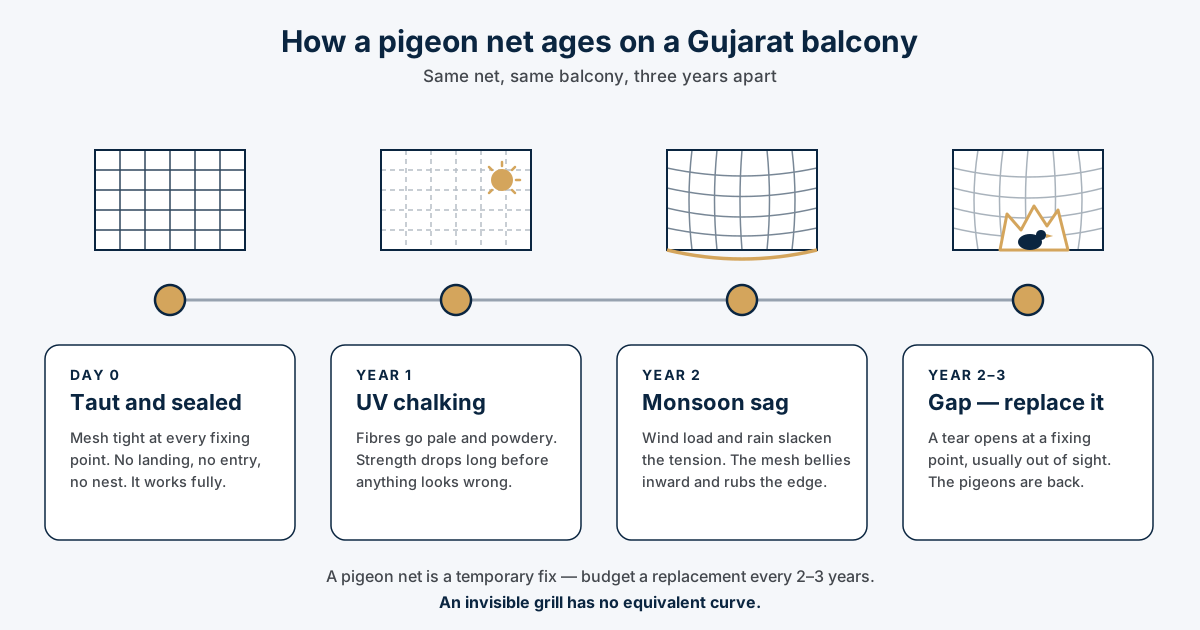
Its weakness is entirely on the second axis, and it is the reason we describe a net as a temporary solution on every page that offers one. UV light makes the fibre brittle, monsoon wind and water slacken the tension, and by year two or three there is a gap — almost always at a fixing point or along the top edge, out of your sightline. Budget a replacement every 2–3 years. Our post on how long a pigeon net actually lasts covers the three failure modes and the two-minute check that tells you where yours is in that cycle.
A typical balcony installation is ₹2,500–5,000, and the pigeon net price guide explains what moves a quote inside that band; the per-sq.ft rates are on the pigeon net for balcony page. We install nets in Ahmedabad, Surat, Vadodara, Rajkot and Gandhinagar only — everywhere else in India we fit the permanent option instead.
The invisible grill: the same barrier, without the clock
SS316 marine-grade cables tensioned vertically at a 2-inch pitch across the same opening. A pigeon cannot land on a 2 mm cable and cannot pass between cables 50 mm apart, so it scores the same five on effectiveness — and it scores five on lifespan too, because the failure modes that end a net do not exist. Steel cable does not chalk under ultraviolet, does not stretch and sag after a monsoon, and has no mesh to tear.
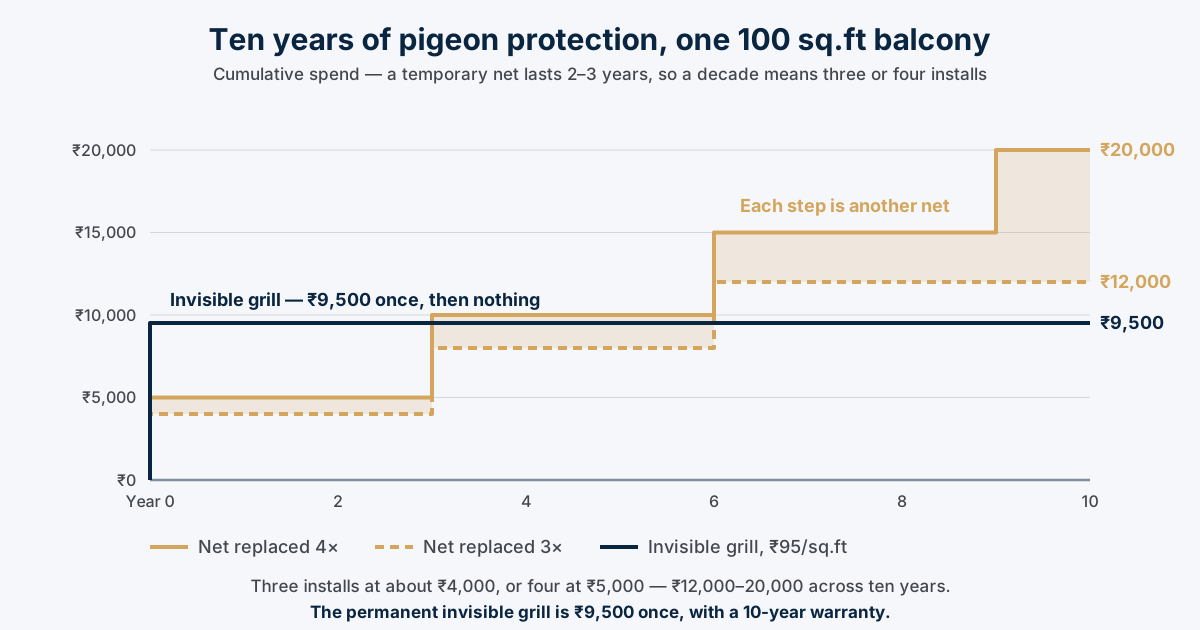
That is the permanent option: ₹95/sq.ft, about ₹9,500 once for a 100 sq.ft balcony, with a 10-year written warranty and no replacement cycle to diarise. The same installation also makes the opening child-safe and pet-safe, which mesh does not, because net mesh is not load-rated. The spec and the cable pitch are on the invisible grill for pigeons page.
Net versus grill, in three lines
Both are barriers, so the choice between them is not about whether they work — it is about time and money. The net is cheaper today at ₹2,500–5,000 and expires in 2–3 years; three or four installs across a decade is ₹12,000–20,000 (the floor is roughly three cycles at about ₹4,000 each; the ceiling four at ₹5,000). The grill is ₹9,500 once for the same balcony and does not expire. And only the grill is load-rated for a child leaning on it.
That is the summary, not the argument. The full side-by-side — upfront cost, ten-year cost, appearance, maintenance, who each one is actually right for — is laid out row by row on the pigeon net vs invisible grill page, and that is where to go if you have already decided you want a barrier and are choosing between the two.
What we would actually fit, and where
Walk your balcony once and answer one question: are the pigeons standing somewhere, or are they getting in?
Standing on one defined ledge, never coming inside. Spikes on that ledge, mechanically fixed, enough rows to cover its full width. Not our product, and the right answer for that problem.
Getting into the balcony, or nesting behind the AC. A barrier across the opening, and across the AC ledge too. Nothing else closes it. Choose the temporary net or the permanent grill on how long you will live there.
Going into a shaft or a shared duct. Same barrier logic, but usually a society decision rather than a flat-owner one — raise it with your secretary before anybody quotes you.
Anything sold as a repellent — gel, ultrasonic, decoys. Skip it. Individually cheap, collectively the most expensive line item on this page over five years, and the months spent testing it are months of droppings on the floor.
If you would rather not make that call from a blog post, a free site survey covers it: the surveyor marks where the birds are actually getting in, measures the openings, and quotes both barrier options on the same visit — so you are comparing them on your balcony rather than in the abstract. And if the honest answer turns out to be a spike strip on one ledge, we will tell you that too.
Frequently Asked Questions
Common follow-up questions on this topic.
Do bird spikes work for pigeons on a balcony?
On the strip of ledge they cover, yes — a properly fitted spike row genuinely stops a pigeon standing there, and that is a real effect rather than a scare trick. The problem is that a balcony is not a strip. Spikes cannot be fitted across the opening itself, so the bird that can no longer stand on the parapet lip flies past it and lands on the AC unit, the shelf, the floor or the corner behind your stored things. Two more practical limits show up on Indian balconies. Most parapets are wider than the single row a quote covers, and a bird will simply stand on the uncovered half. And an adhesive-fixed strip on a west-facing parapet in a Gujarat summer is sitting on a surface far hotter than the air, which is where the base lets go. Spikes are a perch deterrent for one narrow surface. They are not an answer to pigeons on a balcony, and we do not sell them.
Is anti-roost gel worth it in Indian conditions?
We would not use it, and heat is the main reason. Polybutene gel works by staying tacky, and tacky is a property that changes with temperature — on a sun-facing parapet the surface runs much hotter than the air around it, and the gel thins, spreads and creeps down the masonry rather than staying in a neat bead. Then dust does the rest: airborne grit sticks to the surface, cakes, and within months you have a hard crust that a pigeon can stand on quite comfortably. So you are re-applying over a stripe of grime, or scraping and solvent-cleaning it off a porous stone that may keep the stain. There is a welfare problem on top of the practical one. A bird that gets properly gummed loses the waterproofing of its feathers, and that is a slow, avoidable harm — which is why gel fails the no-harm test as well as the value test.
Do ultrasonic pigeon repellers work?
No, and the reason is simple enough to check before you spend anything. Pigeon hearing sits in roughly the same range as human hearing, so a device that is genuinely inaudible to you is very likely inaudible to the bird as well — and any device loud enough for the pigeon to notice is loud enough for your neighbours to complain about. Even where a sound is audible, it is a scare stimulus, and pigeons habituate to scare stimuli quickly: an unchanging noise that never predicts anything unpleasant is treated as background within days. This is the same curve that finishes off plastic owls and reflective tape. There is no credible evidence of a lasting effect on pigeons, and there is no version of the product that changes the physics of an open balcony.
Bird spikes or pigeon net — which should I choose?
It depends on whether your problem is a perch or an opening, and for most flats it is an opening. If pigeons only ever stand on one narrow ledge and never come inside the balcony, spikes on that ledge are a reasonable and long-lasting answer — we do not sell them, so we have no reason to talk you out of it. If they are getting into the balcony, nesting behind the AC unit or going into a shaft, no amount of spiking closes that, because spikes cannot span an opening. That needs a barrier. The pigeon net is the temporary barrier: roughly ₹2,500–5,000 per install, replaced every 2–3 years, and we fit nets in Ahmedabad, Surat, Vadodara, Rajkot and Gandhinagar only. The invisible grill is the permanent one, at ₹95/sq.ft with a 10-year warranty. Both stop entry outright; spikes were never designed to.
Choose your fix
Temporary net, or a permanent solution?
Pigeon net — temporary fix (2–3 years)
Installed by us in Ahmedabad, Surat, Vadodara, Rajkot & Gandhinagar only
See Pigeon Net PricingInvisible grill — permanent, child-safe
One-time SS316 marine-grade install. 10-year written warranty. No repeat cost, no re-tensioning.
Get Grill QuoteSee the full side-by-side: Pigeon net vs invisible grill → · Hindi mein padhein: kabutar jali vs invisible grill →
Ready to talk?
Free site visit. Itemised quote. No follow-up spam.
Same crew that measured you installs your grill. SS316 marine-grade only. 10-year written warranty.