
The call we get at this stage is rarely about cable grades or mesh sizes. The owner has already decided what they want on the balcony — usually after a monsoon with pigeons in it — and then they hit the obstacle that actually stops the job. “Our society may not allow it.” Sometimes that is a rule someone heard second-hand from a neighbour. Sometimes it is a secretary who has already turned down the flat on the third floor.
So this one is not about products. It is about the committee: what a society typically has a say in when it comes to the outside face of your flat, why nets draw objections that invisible grills usually do not, and how the owners who get a yes go about asking. There is a request letter at the end that you are welcome to copy word for word.
One thing first. We install grills and nets. We are not lawyers, and nothing on this page is legal advice — we are not going to tell you what your society can and cannot do, because that depends on your building, your registered bye-laws and rules we are not qualified to read for you. What we can give you is what we watch happen on site in Gujarat high-rises, week after week.
The short version: ask before you pay, ask in writing, and ask about your specific opening rather than about the product in general. Committees are usually protecting how the building looks from the street, not stopping you from closing a balcony — so the request that gets approved is the one that answers the appearance question before it is asked, with a spec sheet, distance photographs and a precedent from a nearby society.
What a society usually has a say in
The boundary that matters here is not the one you would draw yourself. You think of the balcony as part of the flat, because you paid for it and you stand on it. Society bye-laws commonly draw the line somewhere else: the inside is yours, and the external appearance of the building — the face the street sees — is treated as a shared concern, which is why enclosures, cladding, air-conditioner placement and window changes tend to show up in the same paragraph of the same document.
Above the society there are building and development-control norms that cover balconies as a structural matter: what may project, what may be enclosed, what counts as built-up area. Those are real, and they are also exactly the kind of thing we will not interpret for you. If a committee raises them, the person to ask is a lawyer or the society’s own architect, not an installer with an opinion.
What that means in practice is narrower and less alarming than it sounds. In our experience, committees are not usually asking whether you may make your balcony safe. They are asking what it will look like from thirty feet away, whether the rest of the wing will now ask for the same thing, and who is responsible if something goes wrong on the wall. Answer those three questions convincingly and most of the objection disappears. Argue about whether they have the authority to ask, and you will be arguing for months.
Why committees object to nets more than to invisible grills
This is the part where our commercial interest and the honest answer point the same way, so take it with that in mind and then go look at a tower yourself.
Nets arrive one flat at a time. The second-floor family buys green, the fifth-floor family buys white because that is what was on the van, the eighth floor has black mesh from a different vendor with a different weave. They are fitted at slightly different heights and to slightly different edges, and they age on their own schedules — a two-year-old net sags where a new one is taut, and the two to three year lifespan of a pigeon net means the elevation is never uniform for long, because somebody is always due for a replacement. Stand across the road and the building reads as netted. That is the thing committees are reacting to, and once a secretary has watched it happen on one wing, the rule that follows is usually written about nets specifically.
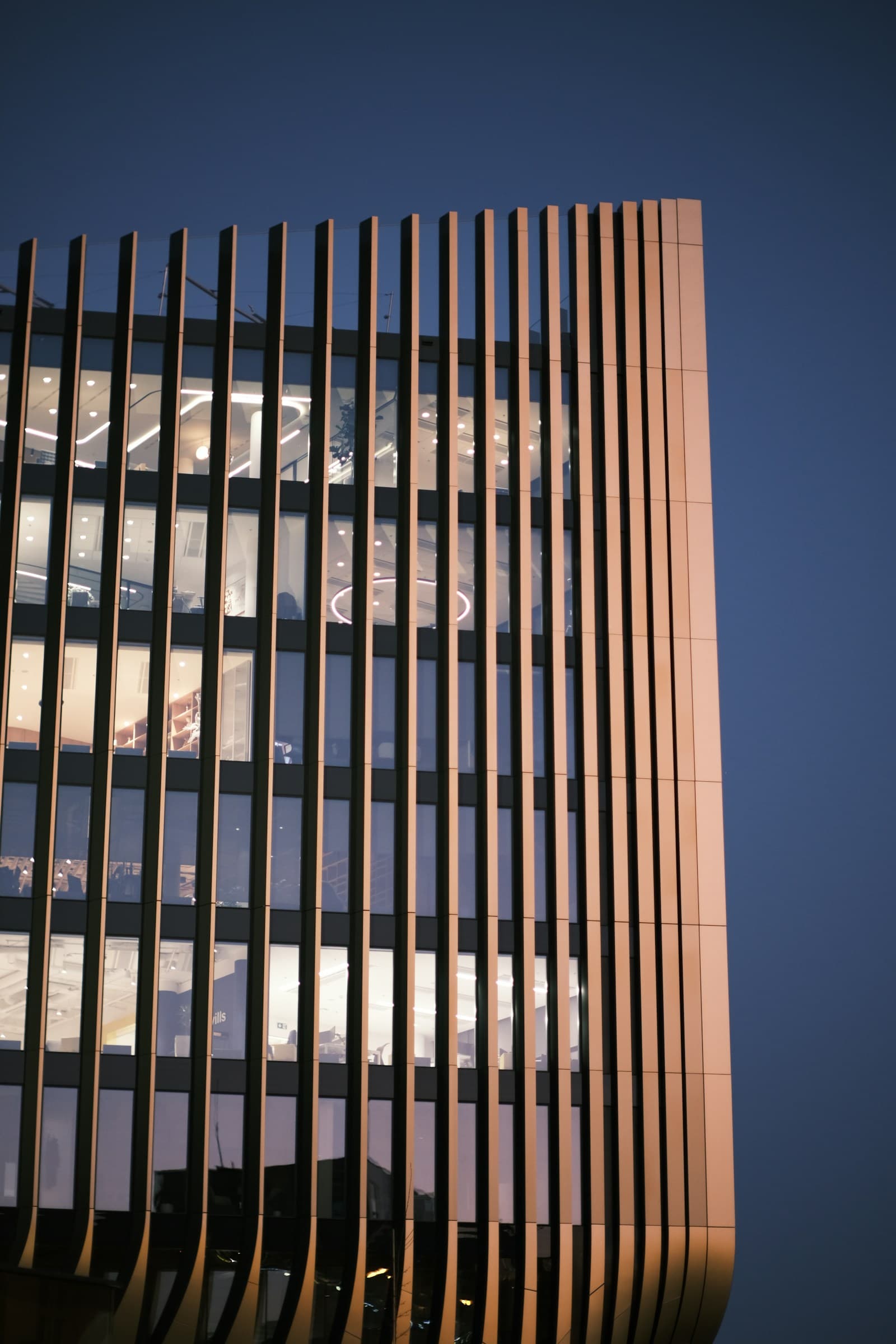
An invisible grill presents differently, and the reason is physical rather than promotional. There is no panel and no mesh — just vertical SS316 cables under tension at a 2-inch pitch, sitting inside the opening on a slim track. From the street the cables read as fine vertical lines against the shade of the balcony, and at facade distance most people do not register them at all. There is no colour to mismatch, no sag to develop, and no replacement cycle to keep the elevation uneven. If every flat in a wing fits one, the wing still looks like the wing.
That is the argument to put in front of a committee, and it is worth putting visually rather than verbally. A photograph taken from across the compound does more than a paragraph of description, because the committee is trying to imagine exactly that view and cannot.
How owners actually get a yes
The requests that get approved tend to look the same. They are short, they are specific about one opening, and they arrive with the answers already attached.
A written request naming the exact opening. Flat number, which balcony or window, and the dimensions if you have them. A committee can approve a specific thing far more easily than it can approve a category.
A product spec sheet. Material and grade, cable pitch, track colour and fixing method — for us that is SS316 marine-grade cable, a 2-inch vertical pitch and an anodised aluminium track. Attach it rather than describing it. It signals that the work is a specified job, not a man with a drill.
Photographs from a distance, plus one close-up. The distance shot answers the facade question; the close-up answers the “is it actually strong” question. Include both, in that order.
Installer details. Who is coming, how long the work takes, whether any lift or scaffolding access is needed, what happens to the debris. Access and mess are what the secretary has to manage on the day, and volunteering the answers buys a surprising amount of goodwill.
A commitment to a uniform appearance. Offer, in writing, to fit the same specification and colour that any later flat would be asked to match. This turns your request from a one-off exception into a standard the committee can reuse, which is usually what it actually wants.
Then there is the move that works better than all of the above put together: precedent. If there is an approved install in your own society, name the flat. If there is not, find one in a comparable building nearby — the same kind of tower, the same kind of elevation — and offer the secretary the photographs and, if the other owner is willing, the other secretary’s contact. Committees are far more comfortable being second than first. We keep local install photographs for exactly this, and we hand them over on request; if you are asking about a permanent install, our invisible grill for pigeons page has the spec you can forward as-is.
Two practical notes. Get the yes in writing, even if it is a one-line email or a line in the meeting minutes — a verbal approval from a secretary whose term ends next year is worth very little in an argument two years from now. And if you rent, ask the owner in the same breath; neither permission substitutes for the other.
A request letter you can copy
Fill in the brackets, attach the spec sheet and the photographs, and send it to your secretary. Keep it to one page. It deliberately asks rather than asserts, and it does not argue about anybody’s authority.
To the Secretary and Managing Committee, [Society name], [Date]
Subject: Request for permission — balcony safety enclosure at flat [Flat no.]
I would like to request the committee’s permission to install a balcony safety enclosure at flat [Flat no.], on the [balcony / window] facing [direction or side]. The purpose is [pigeon-proofing the balcony / child safety / both].
The proposed installation is an invisible grill: vertical stainless steel cables tensioned inside the existing opening on a slim track, with no mesh panel and nothing added to the outside face of the building. I am attaching the manufacturer’s specification sheet and photographs of a completed installation, including one taken from a distance so the committee can see how it appears from outside the building.
I am happy to install to whatever colour and specification the committee would like to standardise on, so that any later installations in the building match this one. The work takes approximately [duration] and [is carried out from inside the flat / requires the following access arrangement: — confirm with your installer]. The installer will remove all debris the same day, and the installer’s details are attached.
If the committee has any concerns about the appearance or the fixing method, I would be glad to discuss them, and I am happy to arrange for the installer to answer any technical questions directly. I will not begin any work before receiving the committee’s written approval.
Thank you for considering this request.
[Your name], Flat [Flat no.], [Contact number]
If the answer is still no
Ask what the objection actually is, and ask for it specifically. There is a large difference between “nothing on the street elevation” and “nothing that shows a colour” and “no drilling into the parapet”, and each of those has a different next move. A no to the street-facing side is often a yes on the inner face. A no about colour is a conversation about the track finish.
If the committee is worried about setting a precedent, offer to be the precedent on the committee’s terms: propose it as a standard for the whole wing, at a meeting, with the spec sheet circulated in advance. It moves slower and it works more often, and it turns the neighbours who would otherwise be the objection into the reason to approve it.
And if the balcony genuinely cannot wait while the committee meets, a pigeon net is the temporary option — a two to three year fix, and we install nets in Ahmedabad, Surat, Vadodara, Rajkot and Gandhinagar only. Ask the committee about the net separately rather than assuming a temporary product needs no permission; the pigeon net price guide covers what it costs and what the replacement cycle looks like, and our pigeon net page has the spec sheet you would attach.
What to do this week
Send the letter. It costs you ten minutes and it is the single step that separates the owners who get this done from the ones still saying “our society may not allow it” a year later. While you wait for the reply, work out what you are actually closing — the balcony face is rarely the only opening, and the guide to the four entry points walks through the ones people miss.
If it would help, a free site survey gives you the measurements, the quote, and a set of photographs and specifications formatted so you can forward the whole thing to your secretary without editing it. And if the committee’s real question turns out to be about the children rather than the pigeons, the same install answers both — which is the argument we make in one install, two problems.
Frequently Asked Questions
Common follow-up questions on this topic.
Can my society legally stop me from putting up a balcony net or an invisible grill?
The honest answer is that it depends, and we are not the people to give you a ruling on it — we install grills and nets, we are not lawyers, and nothing we say here is legal advice. What we can tell you is the pattern we see in practice. Housing society bye-laws commonly cover the external appearance of the building and the use of common areas, and in many buildings the facade is treated as a shared surface rather than something that belongs to the flat behind it. There are also building and development-control norms that sit above the society and cover things like projections and enclosures. How all of that applies to your specific flat, your society's registered bye-laws and your state's rules is a question for a lawyer or the society's own advisor, not for an installer. The practical path forward is almost always the same one: ask in writing, find out what specifically is being objected to, and deal with that objection rather than with the word no. In our experience a committee that has said no to a product has usually said no to how it looked, and that is a solvable problem far more often than owners expect.
Do I need permission for an invisible grill if it is inside my own balcony?
We would ask anyway, and we would ask before install day rather than on it. An invisible grill sits inside the balcony opening on an anodised track and changes very little about how the building reads from the street, and most societies we work with treat the request as a formality — a short email to the secretary, sometimes a one-page form, occasionally a mention in the next committee meeting. That is a cheap thing to do. The expensive version is the one where a crew is on site with a drill and a watchman stops the work, because now you are rescheduling an installation and having an argument at the same time. Ask early, keep the reply, and if the reply comes on WhatsApp, send a short email back summarising it so there is something written down. If you rent, ask your landlord in the same message — the society's yes does not cover the owner's, and the owner's does not cover the society's.
My society has banned nets. Does that mean grills are banned too?
Not necessarily, but do not assume it, and do not let an installer tell you the ban does not apply to you. Take the ban at face value and ask the committee as a separate question, because a rule written about nets was usually written about what nets looked like on that particular facade — colour, sag, the patchwork of different meshes on different floors — and an invisible grill is a visually different proposition. That argument is worth making honestly rather than as a loophole: show the committee photographs from thirty feet back, not close-ups, and let them judge the facade view for themselves. Sometimes the answer is still no, or no on the street-facing elevation and yes on the inner face. That is a real answer too, and it is better to have it in writing before you pay anybody.
Who pays if the installation damages the facade or the parapet?
Settle this before install day, in writing, with whoever is doing the work. The normal expectation for a professional installer is that it is responsible for its own drilling and fixings, that it makes good what it disturbs, and that it removes its debris — and the way to make that more than a nice sentence is to have it in the quote or in an email rather than in a conversation. Ask the specific questions: what does making good mean here, who pays for the paint if the parapet needs touching up, and what happens if the grill comes out in five years and the anchor holes have to be filled. It is worth being clear that a product warranty is a different thing from this. Our 10-year written warranty covers the grill — the cable, the fittings, the workmanship on the install — and it is not a facade insurance policy. Committees ask about this more than owners do, and having a straight answer ready is part of why some requests get approved and others sit in a file.
Choose your fix
Temporary net, or a permanent solution?
Pigeon net — temporary fix (2–3 years)
Installed by us in Ahmedabad, Surat, Vadodara, Rajkot & Gandhinagar only
See Pigeon Net PricingInvisible grill — permanent, child-safe
One-time SS316 marine-grade install. 10-year written warranty. No repeat cost, no re-tensioning.
Get Grill QuoteSee the full side-by-side: Pigeon net vs invisible grill → · Hindi mein padhein: kabutar jali vs invisible grill →
Ready to talk?
Free site visit. Itemised quote. No follow-up spam.
Same crew that measured you installs your grill. SS316 marine-grade only. 10-year written warranty.

